
thread direction 120 deg ignition bolt,

hello all,
just asking, as I doubt cant rely on my memory for most things anymore, for 120 SFC bolt that holds ignition rotor on,
would somebody please confirm if this bolt is left hand or right hand thread, before I do something stupid,
i'm fairly sure it is not LH.
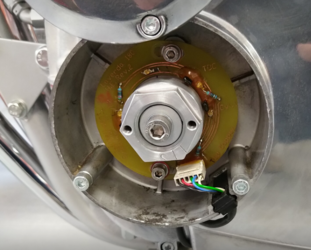
borrowed the image from breganzane's previous post,
as mentioned in the post, my aim is to get my rotor machined to be like this, currently mine has no flats.
thanks for any help,
Stuart

1658134609645.png
 
The Allen bolt is standard as above, but check for a small set screw also, which screws into the keyway on the crankshaft. Then the rotor pulls straight off.
 
I am fairly sure that 120's can have either LH or RH, someone confirm? if that is the case, they probably started out with RH and found that it is not good , so reverted to LH as on the 180's
because of the rotation of the crank engineering wise, it should of course be LH
CLEM
 
It is always: tightens against the rotation direction. If you look from the left side into the ignition cover, the Crank runs COUNTER clockwise, so this screw tightens CLOCKWISE. Same for the nut behind the rotor.

From right side where the free-wheel is, the engine runs clockwise => locking nut is counter-clockwise. This was on all Type II (ND) 180° and all 120° engines I had my hands on and the only thing that makes any sense to me. Not sure if it is any different on the Bosch engines maybe, as I have seen at least 2 engines where the right side cover was scratched through from the inside out by the nut... Never seen that on any type 2 engines (if not fallen on the side...)

But then - who am I ...:cautious:

;)
 
Last edited:
I am fairly sure that 120's can have either LH or RH, someone confirm? if that is the case, they probably started out with RH and found that it is not good , so reverted to LH as on the 180's
because of the rotation of the crank engineering wise, it should of course be LH
CLEM
The MkII/120 can have differing threads for the alternator fixing bolt. While the vast majority seems to be RH thread, there are also quite a few LH thread bolts, these can be recognised by the machined hex head.

piet
 
I thought so, but I have limited experiance of 120's, am I right in thinking that LH bolts/nuts have a "nick" cut on the outer edge of every corner, in the centre of the face to denote LH, or is that just sometimes/ some manufacturers?
CLEM
 
[For clarity, there's been some deviation onto the topic of the Alternator bolt (on the other side) here... ALL of the ignition pickup bolts on the left side of the engine are RIGHT hand threads.]

Clem the LH Alternator bolts are completely 'bare', from what I could see that's because they're a machined 'custom' bolt (made in-house or by a small volume supplier) rather than a typical mass produced rolled and stamped bolt. The RH bolts have a typical head marking (SBE most likely?). The nicks in the head corners are typical in LH thread gas fittings, but do not apply here.

I had some fun looking for one of those bolts last year when finishing off a mate's 81 Jota. Thanks to Piet I knew what to look for and spotted the LH thread bolt when disassembling, which went smoothly. When reassembling, the bolt clicked off to torque and I ran the bike a few times but then about third start the starter just spun. I took the cover off and found the alternator loose. Strange, I'm sure I torqued it a month or two back before all that stuff went together. I retorqued it, clicked off, put it back together. Again after a few starts the starter just spun. A great pit of dispair opened up below me as I worked out what was going on... please Massimo.... let it be the bolt and not the thread in the crank!

Thankfully it was indeed the bolt which was elongating (probably someone previously trying to undo it and just tightening it further?) so then I cast around looking for a fine pitch left hand thread bolt. They're pretty easy to find, just google hens teeth and rocking horse poo suppliers. I think I found one supplier far away, but freight was very iffy mid-covid and the bolt would have ended up costing over $100 and take weeks to arrive at best so I made a new one from some 4140 I had on hand. Bit of a tedious exercise but solved the problem same-day and is still working well.
 
Gee, iis still being used, i used the very best parts that could be bought at that time, unlike modern times. Ok the magnet carrier or "impulse rotor" as oem described. M5 tapped holes allow any flat bar with correct spacing holes and appropriate length M5 screws will allow a safe crank rotation when installing or servicing the motor. The flat bar also allows the rotor to be "pulled" as i used a reamer for correct bore diameter, can become a tight fit over time. Had no access to any milling machinery. Early magnets were neodymium, 10m/m and suffered from permanent Currie point failure on some engines. Quickly replaced with Samarium Cobalt when field reports came in. Still have some 120 type carriers and magnets in stock should any of the rotors in this post suffer from Neodymium magnet issues.

Straight forward to view the Neo magnets, they are silver unlike the SmCo magnets which are grey and very very brittle DO NOT strike or impact the surface of the SmCo magnet, also the diagnosis of weak magnet is straight forward on a hot motor the leds on the encoder board will indicate a low magnet strength not triggering a Hall Effect sensor. HTH j.
 
Thanks all, this is mine, I think the bolt is what was originally there before adding the IIS, a bit hard to remember as it was 15+ years ago, maybe 20!!!
Mmmmm may be mistaken, looks like the M5 internal thread has been drilled out? Pretty sure that rotor will be a Neo magnet, say about 10% or less of the Neo's lost magnet strength, was not that many over the years. Just something to keep in mind once on the restore ride journey.... am here as it may be of use. j
 
Hi John, the holes are still 5mm,
I have decided to keep it simple and make a fixing as you described, 2 x standoffs and a flat bar, plus 2 x 5mm bolts.
I have said before. the IIS is the single best improvement I made.
Cheers, Stuart
 
Early magnets were neodymium, 10m/m and suffered from permanent Currie point failure on some engines.

They were never meant to be curried! Perhaps if you just pickled them and put in a salad they'd still hold their magnetism.

Feeding magnets to cows is common practice, but never heard of it for people before now.
 
Remind me not to eat anything at your place Cam, you may have the tins labeled "Currie" and "Curie" mixed up, unlike myself... as i see no difference... unless i notice the steel table knife sticks to me at the table.... then it would be too late, a smile here....j
 
Back
Top